Everything is Writing

It’s been almost two weeks since I have done anything substantial on my work-in-progress, and I have been beating myself up for it.  I have good reason for the hiatus – I am facing a deadline for an e-course I am developing, and so I had to make that a priority.  So it’s not like I’m goofing off or even not writing.  But still, there’s always that fear that I will lose my momentum, that stepping away from a project will mean that I will never return to it.

Which is kind of ridiculous, actually.  I mean, have I met myself?  Slow and steady and following through is kind of my thing.  But it’s so frustrating when I don’t have time to focus on a project.  The common wisdom is that you have to put in the time every day, right?  That’s why I found the interview with Anne Rice in the November/December 2013 issue of Writer’s Digest extremely comforting.  She said:

“Whether [or not] I hit the keyboard, I’m writing in my head.  I’m working on my books all the time.”

I realized yesterday, as I worked out on important plot point in the car on my way to work, that this was true.  So I need to stop thinking that putting words on the page is the only thing worth doing.

Still, I am super-proud of myself that I managed to get up early and write 164 words before getting my son up for school.  Every little bit helps.

Signing Helps Young Children Understand Feelings

pumpkinHalloween is the perfect time to talk about feelings with young children – and American Sign Language is a wonderful way to help children connect visual cues with feeling concepts, to help them develop an understanding of their own feelings as well as empathy for the feelings of others.  Here’s a fun song to introduce feeling signs to kids.  Extend the activity by drawing a simple pumpkin face on a whiteboard and asking the child to help you draw the appropriate expressions for each feeling.

“Pumpkin Feelings” (Click on the links to see videos of the key signs)

If you’re a happy pumpkin, clap your hands. If you’re a happy pumpkin, clap your hands. If you’re a happy pumpkin, then your face will show us something, so If you’re a happy pumpkin, clap your hands. Little Hands and Big Hands coverFind more hands-on signing activities like this one in Little Hands and Big Hands: Children and Adults Signing Together by Kathy MacMillan, photographs by Kristin Brown.  (Huron Street Press, 2013).

How Signing Enhances Early Literacy

Excerpted from Little Hands and Big Hands: Children and Adults Signing Little Hands and Big Hands coverTogether by Kathy MacMillan (Chicago, IL: Huron Street Press, 2013)

Whenever you communicate with your child in an involving way, you are helping her develop early literacy skills.  Because signing encourages communication and engagement, it supports early literacy.  But that’s not the only way signing helps your child develop language and literacy skills.  In her groundbreaking book, Dancing with Words: Signing for Hearing Children’s Literacy (2001), Marilyn Daniels describes her research on using American Sign Language in preschool classrooms with hearing children.  More often than not, her research was disrupted when the parents of her control group (a preschool classroom where the teacher was not using sign language with the students) heard about the amazing gains the signing classrooms in the study were making, and insisted that their children be exposed to sign too!   She found that hearing preschoolers and kindergarteners in the signing groups achieved significantly higher scores on the Peabody Picture Vocabulary Test than those who knew no sign.  In addition, teachers in the signing classroom reported that their students were less frustrated, got along better, and were more excited about learning than their previous, non-signing classes.

How did signing with these groups produce such extraordinary results?

  • Sign language supports different learning styles.  Signs provide a visual cue and give kinesthetic learners, who learn best through physical activity, a way to interact with letters and vocabulary.
  • Knowing the names of the letters of the alphabet is an important first step on the road to literacy.  Using the manual alphabet with children helps them learn, remember, and use the letters – long before they have developed the fine motor skills to write them clearly.
  • As children move into the preschool and early elementary years, knowing signs and the manual alphabet allows them to access two different “memory stores” in their brains for reading, spelling, and vocabulary.  For example, if a child cannot identify a letter’s sound, signing it to himself may help jog his memory to make the connection.
  • American Sign Language, like any language, stimulates the language centers of the brain, strengthening synaptic connections and preparing them for further language learning.
  • Young children tend to be more visually attuned than adults, and so signing to them naturally captures their attention.  In addition, our visual sense works best when our eyes are moving, as when one is observing signs.
  • The areas of the brain that control movement develop earlier than those that control speech.  This is why even six to seven month old babies can produce signs.  As children grow up, their motor centers continue to develop ahead of their speech centers, allowing them to express more thoughts more clearly through signs than they can through speech.
  • Adults tend to use writing as a way to process and understand information.  Young children do not have access to this tool yet, but they can use signs to serve the same function.
  • The hands are connected to the brain.  Developing the tactile sense (touch) and the kinesthetic sense (movement) helps the different hemispheres of the brain communicate with one another, allowing for more seamless processing of information.
  • Before children can understand the abstract shapes of letters, they must first develop their proprioceptive system, or a sense of where they are in space.  When a child moves, proprioceptive development is triggered as muscles, joints, and tendons make contact and brain connections develop (Johnson 2007).  The movement of signs naturally encourages proprioceptive development.
  • Signing in itself seems to be intrinsically motivating for children; as one United Kingdom study reports, “Children’s motivation for acquiring basic signing skills does not appear to stem from interaction with Deaf children or adults as much as from the language itself” (Daniels 2003).
  • Signing with children facilitates a sense of play.  Play is far more than just simple entertainment – it is the number one way children learn about the world in the first five years of life.  Play allows children to make connections between concepts and understand how the pieces of the world fit together – and if children figure these things out for themselves, the resulting brain connections last far longer than if they had received direct instruction.

For more about the benefits of signing with young children, as well as fun signing activities to use with children, see Little Hands and Big Hands: Children and Adults Signing Together by Kathy MacMillan available now!

Getting Out There

Last Saturday I made myself get out there and attend the Society for Children’s Book Writers and Illustrators regional conference.   Despite the fact that I have been writing with increasing degrees of seriousness for the last ten years, this was my very first writing conference.  I was not really looking forward to it;  I registered out of a sense of duty.   After all, if I am going to have mainstream books to promote soon, I will need to be out there more.  I need to force myself to – gulp – talk to people.

The morning session was fine enough, but I was still nervous.  And then, as I was getting a cup of tea, I saw a short woman walk by.  I thought, “Wow, she looks like Betty May” – Betty May, in whose children’s theater group I performed for ten years.  Betty May, who was without a doubt one of the formative mentors of my childhood.  Betty May, who was the first adult I ever met who knew how to respond when I randomly burst into tears.  (That happened often when I was a child – there’s a whole other post in that.)

betty
Me and Betty May, my hero.

Then I looked more closely, and realized that it WAS Betty May.  So I called out to her, we hugged and caught up.  And she is doing amazing things, just like she always has.  (Seriously, she just directed this play at the Kennedy Center.  She’s amazing.  Click on the link and go read the article.  I’ll wait.)

And as I stood there talking to her, I didn’t feel like a writer.  I didn’t feel like someone who communicates for a living in all my weird careers.  Because there were absolutely no words to tell her what she meant to me, what her quiet acceptance of me just-as-I-was meant to me as a kid, and still does now.    I hope the giant hug I gave her before she left conveyed even a tiny piece of it.

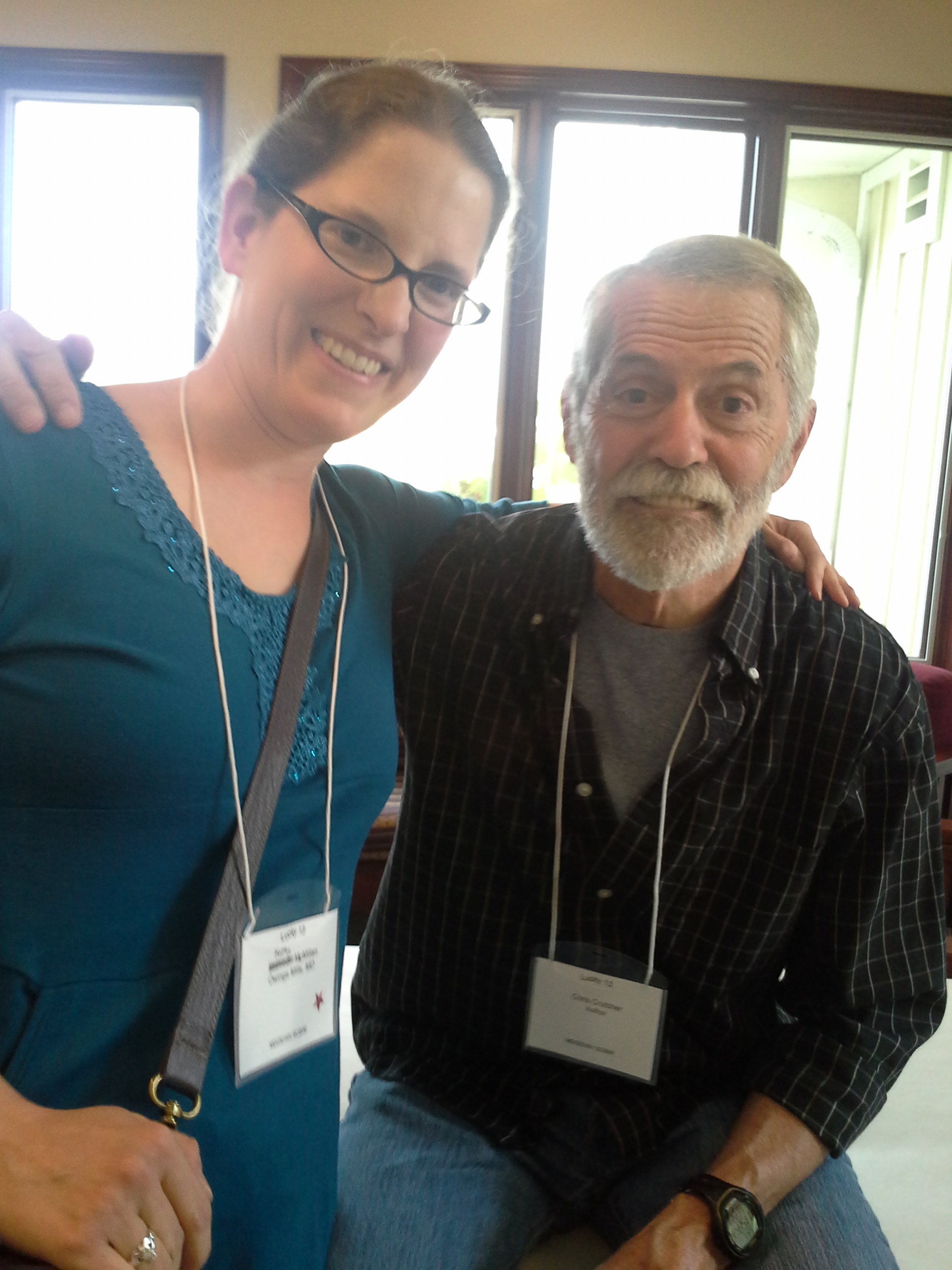
By the time we had started talking, the hallway had cleared out, and there were only a few people left to ask to take a picture to commemorate this reunion.  So guess who wound up taking our picture, and then standing around talking to us for the next hour?  Self-proclaimed “author and loudmouth” Chris Crutcher, who is, in a word, awesome.    Words fail me again when I think of the passion and humor he brought to his conversations with me and the other starry-eyed newbies at the conference.Me with Chris Crutcher!

And guess what?  I even managed to make some friends at lunch.  Other writers aren’t nearly as scary as they are in my head.

I still had to go and sit in an introvert’s time-out to recover when I got home though.  Some things take time.