Writing Around the Point

Whenever I sit down to work on my novel in progress, I try not to think too hard about the fact that I am eventually going to cut 70-90% of what I write on any given day.  It’s painful to think about, even if it’s necessary.

So it’s weird that I have totally embraced another writing technique: writing outtakes.  For my current work in progress, I have written nine different outtakes and extra scenes, ranging in length from 15,000 words to 22,000 words.  Every time I do it, I feel like I am wasting time, or at the very least, indulging in what I like to call “productive procrastination”.  (If you spend your time organizing your to-do list to avoid actually doing anything on it…that’s productive procrastination.)  Some of these stories are scenes from the novel in other points of view, some are completely separate, some are background information that I need for the main story.  At two key points in the story, where several characters converge, I actually found it helpful to write the scene in several other characters’ points of view BEFORE I tackled it from my main character’s viewpoint.

So now, whenever I am struggling with my manuscript, I set it aside and choose another character to write about, or pick a moment in the past to write about.  Then when I come back to the main manuscript, more often than not, I have a much better idea of how to proceed.  It makes sense; if you got stuck writing an article or nonfiction topic, it would probably be because you need to do more research.  These side stories are “research” on my characters.  I have pages and pages of notes…
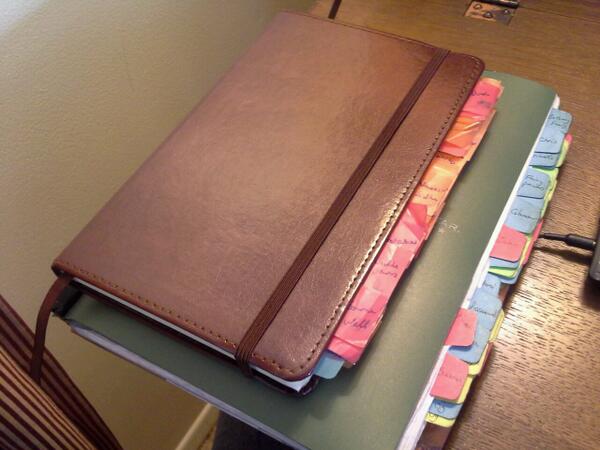
notes


…but for some reason it doesn’t all become “real” to me until I write it in prose form.  My characters tell me things I hadn’t known before when they start interacting with others.

Right now I am finally working on the climactic scene of my work-in-progress, a scene where five characters and their messy hopes, desires, and insecurities collides.  I tried plotting it using color-coded index cards…
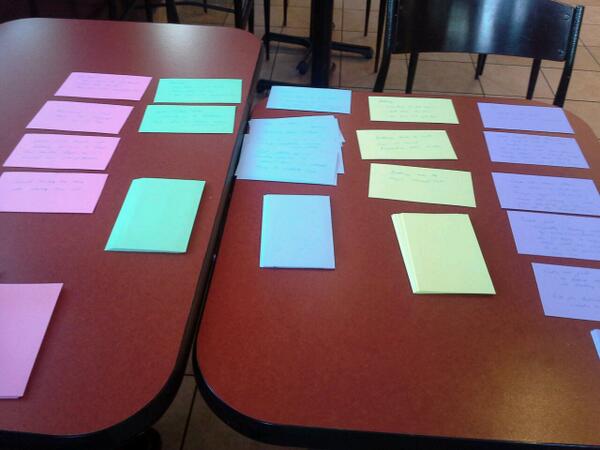
cards

…scribbling notes in notebooks, adding half-formed notes to Word documents.  And I have been working on this scene from the other characters’ points of view first, starting with the villain.  (Writing in her point of view may not be healthy, but it’s useful.)

So here’s my resolution: I am no longer going to let myself feel guilty about this.  It’s not a waste of time.  It’s necessary to make the final product better, because when it comes to writing a great story, there’s just no way to rush it.

Epiphanies

As we were driving home from church yesterday, my son and I were talking about Epiphany – in the religious sense – and epiphanies –in the James Joyce sense of “sudden and momentary showing forth or disclosure of one’s authentic inner self”.  I told him my favorite epiphany story – the story of how I realized that I had to be a librarian. I was in the fall semester of my last undergraduate year at the Catholic University of America, and one evening – I remember very clearly that it was a Tuesday around 5 pm – I walked into the university library stacks, breathed in and thought, “I love the smell of books”.

Now, my memories of the next few minutes may be a little skewed, but I am pretty sure the ceiling opened up and a bright light shone and angelic voices sang. Or maybe that’s just how it felt. Because in that moment, I knew, without the slightest doubt, that I had to be a children’s librarian. I knew that, in my soul, I already was.

The reason I remember that this happened on a Tuesday night around 5 pm is that I had my children’s literature class that evening, and I remember arriving early and pelting the professor, Kristi Beavin (head of the children’s department at Arlington County Library), with questions about library school. I was so excited that I called just about everyone I knew that night, and stayed up all night researching library schools on my slow dial-up internet connection.

As much as that moment felt like a sudden revelation, it was really more about making a connection. All the clues had been there before. I loved children’s literature, and I had already started preparing graduate school applications for an MA in English, figuring that I would become a professor in that field.  I had adored libraries since I was a child. Books were my best friends. (My mom, in fact, had had a middle-of-the-night epiphany a few years before, at the time when I was an unhappy musical theater major, that I should switch to English, a major I had never even considered before despite the fact that I loved books and writing and I had been editor of the literary magazine in high school.)  I was already taking a children’s literature course in the education department and had been hearing about children’s services in libraries all semester. When I had presented the story “Mr. Fox” during class, the professor had written on my grading sheet: “You have a future as a storyteller, if you want one.”  (Note to teachers:  Don’t think your students don’t listen to you.  Look how I make a living now.)

So, all in all, when I look back at that moment, I think: what the hell was wrong with me? Why didn’t I see it until that moment? It was that moment of pure physical presence among the books (and, as my friend Marie Flanigan would say, perhaps being addled by the smell of book mold) that did it.

So after telling my son that story, I started thinking: what about becoming a writer? Was there an epiphany about that? And the answer is: nope. But I have always been writing, from the time that I wrote (bad) poems for extra credit using my spelling words in middle school.   (Maybe one day I will dig some up and post them here…if I am ever in the mood for complete humiliation.) Whether it was fanciful stories or fanfiction or articles or attempts at real stories, writing was how I always felt most comfortable expressing myself.

So I guess at some point I had a quieter epiphany, a gentler, less startling “disclosure of my authentic inner self” –  not that I wanted to be a writer, but that I already was.


Signs of Christmas

The holidays are a great time to use signs with kids – whether they’re traveling to see relatives, staying up late for midnight mass, or missing naps, holiday times can bring changes, and signing promotes security amid the chaos. image image Make this ASL holiday wreath by gluing the hands into I-LOVE-YOU signs, numbers to count the days to Christmas, or letters to spell out your name! Find complete directions at http://www.storytimestuff.net. Check out this video guide to simple Christmas signs from My Smart Hands, presented by a mom and two kids of different ages – it’s a great chance to see how those little hands actually form the signs.

Sticks and Stones and Iron Ore

More random topics I have gotten to find out more about in the past few weeks, thanks to my work-in-progess:

  • the world record for stone-skipping (51 skips, in case you were wondering.  Also, bet you didn’t know that there is a North American Stone Skipping Association.)
  • the square footage of a particular high school in Frederick County, MD
  • online square root calculators
  • the writings of Lady Gregory
  • jewelry made from iron ore
  • pictures of loincloths
  • guns used by 18th century East Coast settlers
  • symptoms of smallpox
  • legends of the Mimis (fairy-like beings of aboriginal Australia)
  • dolphin physiology

Celebrating a Great Partnership: Clerc-Gallaudet Week is December 3-9

At certain times throughout history, fate has brought together people who were able to do great things together, their collaborations pushing them individually to great heights.  Lennon and McCartney.  Jobs and Wozniak.  Twain and Tesla. Perhaps lesser-known to many hearing Americans is a partnership that happened by fortunate accident but would go on to shape an educational system, a language, and eventually, an entire culture: that of Thomas Hopkins Gallaudet and Laurent Clerc, founders of the first permanent school for the deaf in the United States. clercLaurent Clerc, born December 26, 1785 in the south of France, became deaf as a young child and spent his early years uneducated, with little to no communication with his hearing family members.  Finally, when he was twelve years old, an uncle convinced Clerc’s parents to send him to a well-known school for the deaf in Paris, the first public school for the deaf in the world.  At the school, Clerc quickly learned French Sign Language, reading, writing, philosophy, mathematics and more – so quickly that after just eight years of schooling he became a tutor and was hired as a teacher one year later.   In 1815, Clerc was selected to travel to England with the head of the Paris school for a series of demonstrations of his teaching methods – a trip that would change history. That’s because in attendance at one of those demonstrations was thgallaudet-portraitThomas Hopkins Gallaudet, a hearing man and minister from Hartford, Connecticut who had travelled to England to research deaf education methods for a proposed school for the deaf in the United States.  He had originally come to study at the Braidwood School, an institution that focused exclusively on speech and speechreading, but had been frustrated by the Braidwood family’s refusal to share their methods.  When he attended the presentation by the French educators, Gallaudet knew that he had found what he needed for the American school.  The Frenchmen invited Gallaudet back to Paris with them. Gallaudet soon ran out of money, and recognized that he still had not learned enough to start the school on his own.  He entreated Laurent Clerc to return to the United States with him, and Clerc, moved by the plight of the uneducated deaf children in America, agreed, abandoning the cultured halls of Paris for the wilds of the New World. On their fifty-two day sea voyage across the Atlantic, Clerc taught Gallaudet French Sign Language, and Gallaudet taught Clerc to read and write English.  In 1817, they opened the first permanent school for the deaf in Hartford, Connecticut.  Some students came from the nearby island of Martha’s Vineyard, a community with its own established deaf community and sign language.  Most students came from hearing families where they had eked out a few “home signs”, gestures to communicate enough to get by.  But all found themselves in a rich community where Clerc’s French Sign Language blended with the signs brought by his students, forming early American Sign Language and the roots of American Deaf Culture as we know it today. Clerc and Gallaudet went on to establish or help establish schools for the deaf in many other states, and both devoted their lives to deaf education.  In December 1974, DC Public Library established Clerc-Gallaudet Week as a way of honoring Clerc and Gallaudet’s birthdays (December 26, 1785 and December 10, 1787, respectively) and promoting library awareness in the deaf community and deaf awareness in the library community. To learn more about Clerc and Gallaudet, check out these links: