Summary: Everyone in Phoebe Ferris’s life tells a different version of the truth. Her mother, Meg, ex–rock star and professional question evader, shares only the end of the story—the post-fame calm that Phoebe’s always known. Her sister, Luna, indie-rock darling of Brooklyn, preaches a stormy truth of her own making, selectively ignoring the facts she doesn’t like. And her father, Kieran, the cofounder of Meg’s beloved band, hasn’t said anything at all since he stopped calling three years ago. But Phoebe, a budding poet in search of an identity to call her own, is tired of half-truths and vague explanations. When she visits Luna in New York, she’s determined to find out how she fits in to this family of storytellers, and to maybe even continue her own tale—the one with the musician boy she’s been secretly writing for months. Told in alternating chapters, Phoebe’s first adventure flows as the story of Meg and Kieran’s romance ebbs, leaving behind only a time-worn, precious pearl of truth about her family’s past—and leaving Phoebe to take a leap into her own unknown future.
On the surface this is the story of Phoebe’s trip to New York to visit her sister Luna, who has just dropped out of college to tour with her band. The shadow of their parents’ past looms large, as Luna seems to be making the same choices as her mother at every turn, even as she resents the musician father who walked out on them. But as Phoebe confronts her sister and the secrets she has kept, she also comes to learn truths about her parents and their past, and gains the clarity to make her own choices, despite her fear of repeating their mistakes. As Phoebe comes to understand emotional truths about her parents’ relationship, it is fitting that her mother’s story unfolds in reverse between the chapters of Phoebe’s story, taking us a little further back in time with each appearance, until we see her mother where Phoebe is now, a young woman choosing between fear and hope. A compelling and lyrical exploration of female relationships and choices.
Thank you to everyone who supported me and Sword and Verse this year, whether you came out to an event, read the book, reviewed it, listened to me natter on about it, or just controlled the urge to roll your eyes while listening to me natter on about it.
Some bookish highlights of 2016:
January: Sword and Verse Launch Party/Gala Fundraiser for Deaf Camps, Inc.
February: A Sword and Verse sculpture from my sweetie for my birthday:
March: Making our mark at the Winchester Book Gallery with the other authors on the #BehindThePages tour, Laura Shovan, Ava Jae, and Janet Sumner Johnson.
May: Talking fantasy at the Gaithersburg Book Festival with Martina Boone and Lori Goldstein.
June: Enduring the heat at the Chesapeake Children’s Book Festival with Mia Siegert.
September: Rocking the Baltimore Book Festival (and that floral crown) with Paula Willey, Terry Jennings, and Amie Borst.
September: Living the fantasy life at the Maryland Renaissance Festival.
October: Celebrating Teen Read Week with the #YARoadTrip tour with Lindsey Roth Culli, Tobie Easton, Melissa Gorzelanczyk, Karen Fortunati, Jan Gangsei, Karen Hattrup and Rahul Kanakia:
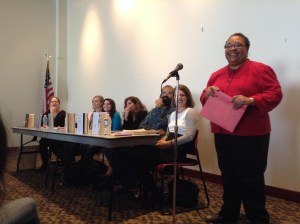
October: Presenting the the Society of Children’s Book Writers and Illustrators Mid-Atlantic Conference with Laura Shovan, Sarah Glenn Marsh, and Erin Teagan.
Bring on 2017!
This writing thing can really knock you on your butt sometimes. Twice this year I got caught up in the maelstrom of negative thoughts, putting so much pressure on myself that I pushed myself to the brink of an abyss of anxiety.
Why does this happen? I suspect it’s different for every writer, but for me it’s because I get caught up in the myth that it’s somehow easy for other people, and if I just push through and push through, somehow it will become easy for me too. But the thing is that making art is hard, even if it doesn’t look it from the outside. But even that thought didn’t help as I was driving toward the abyss last month, because I’d just tell myself that it was hard but that I should somehow be able to just get over it all and do it anyway.
And then a newsletter arrived in my mailbox, from my friend Steph Lagana, a lighthouse in the world, and it told me exactly what I needed to hear when I needed to hear it:
“And this is really important, DON’T DO IT BEFORE IT FEELS RIGHT. It doesn’t need to feel easy. In fact it could be really simple and feel SUPER @#$%&*$ SCARY. See above. It also doesn’t need to make sense. It just needs to feel RIGHT.”
And I suddenly understood why everything felt wrong with the writing project I had been working on. Even though I loved the story, the characters, the premise, I was trying to do it at the wrong time. I had been trying to write with an empty pen.
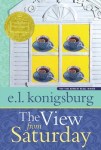
Earlier this year, I reread an old favorite with my son, The View from Saturday by E.L. Konigsburg. One of the characters, Noah, learns calligraphy, and one of the most important lessons he learns is this:
“Filling the pen is not what you do before you begin. It is the beginning.”
(My Sugar Quill people will appreciate the fact that this bit of wisdom appears on page 87.)
My head knew this; I even had several conversations about it with other authors back in October. Yet still I pushed myself, trying to force this book into existence. It wasn’t until I was at my wit’s end that I finally understood this with my heart and decided to take time off from writing altogether.
When I made that decision, it was like a weight had been lifted from my lungs. And I realized the utter ridiculousness of the fear that had been driving my push forward: I was afraid that if I really took a break from writing, somehow I would never be able to start again. This is ludicrous. I have finished six novel manuscripts and nine nonfiction manuscripts; I’ve done it before and I can do it again. And yet the fear persists, every single time. The irony is that there was no way I could find my way back to writing until I let go of it for awhile.
So now I am focusing on the things that inspire me, so that, when the time is right, I can go back to that work in progress with joy and vigor. Here are some of the things that have been filling my pen lately:
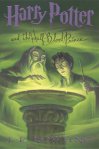
Because any list of what inspires me naturally has to include Harry Potter, and this is the one my son and I are currently listening to. On this listen, I am especially appreciating how well Narcissa Malfoy’s storyline is developed.
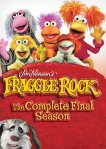
Also a staple of my inspiration. You can’t be uncheered by Fraggle Rock. Here’s one of my very favorite clips. It always inspires me, so maybe it will inspire you too:
Summary: Ella Coach has one wish: revolution. Her mother died working in a sweatshop, and Ella wants every laborer in the Blue Kingdom to receive fairer treatment. But to make that happen, she’ll need some high-level support . . .
Prince Dash Charming has one wish: evolution. The Charming Curse forced generations of Charming men to lie, cheat, and break hearts — but with the witch Envearia’s death, the curse has ended. Now Dash wants to be a better person, but he doesn’t know where to start . . .
Serge can grant any wish — and has: As an executive fairy godfather, he’s catered to the wildest whims of spoiled teenagers from the richest, most entitled families in Blue. But now a new name has come up on his list, someone nobody’s ever heard of . . . Ella Coach.
I just love this book. I read an early version of it, and that was incredible, but now I have just read the final version and I am even more blown away. This is one of those books that I just want to shove at people and say, “READ IT and you’ll understand!”, but I will try to be coherent here in explaining why.
The land of Tyme is the most fully-fleshed out setting I have ever read in a fairy tale retelling. Seriously, there is so much going at every level, large and small, and all of it adds up to a place that feel more real than most stories set in the real world. Then there are the characters: Ella is smart and fierce and determined and funny and flawed – a heroine at once relatable and aspirational. We should all strive to be as awesome as Ella. Watching Prince Dash Charming stumble through the aftermath of the broken curse – and the uncomfortable realization of his own privilege – is at once painful and inspiring. And he and Ella together are just lovely. There are also tons of other incredibly well developed female characters in the story: Sharlyn, the prickly stepmother who shows herself to be one of Ella’s staunchest defenders; Queen Maud, whose moral compass holds more sway over her husband and son than she knows; Jules, the fairy with ulterior motives; and Lady Lariat Jacquard, a villain on par with Dolores Umbridge for pure bile.
Morrison is not afraid to take on big topics from the real world and present them in a way that makes sense to young readers. No one can come away from this story without a deeper understanding of privilege, economic systems, and the importance of fair labor regulations. Morrison takes the central themes of the Cinderella story – rags-to-riches, deceiving appearances – and spins them out into a tale about examining what lies beneath our assumptions about others and developing empathy. And how did I get so far without mentioning Serge and Jasper? The additional layers of story created by Serge’s burgeoning realization that cause to which he has dedicated his life has been corrupted, and by his relationship with Jasper, take this far beyond a typical fairy tale retelling. No series has combined whimsy with compelling issues from the real world as seamlessly as this since Harry Potter.
DISENCHANTED: THE TRIALS OF CINDERELLA is out now.
"There will be people…who want to make you feel as small as they are. Don't let them." -DISENCHANTED: THE TRIALS OF CINDERELLA by @megtyme
The German translation of Sword and Verse, entitled Feuer und Feder, will be published by Beltz on March 13, 2017. The German title translates to “fire and feather” or “fire and quill”. And check out this lovely cover!
 Girls in the Moon by Janet McNally




 Earlier this year, I reread an old favorite with my son,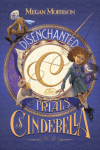






 Stories By Hand with Kathy MacMillan