Category Archives: Works in progress

Constructive Woolgathering

a window looks out onto a blue sky full of cloudsI spent a lot of time today staring out the window.  But it was solid, productive staring out the window.

I am elbow-deep in a revision of my as-yet-untitled novel that is coming out in 2016, and I won’t lie – it’s been rough.  I’ve already done at least four major, all-out revisions of this story, and it’s hard to believe that the process will ever be finished.  As this revision requires rewriting my opening chapters and rethinking the climax of the story itself, it is proving to be the most challenging so far.

But all my staring out the window today, along with some spot-on, why-didn’t-I-think-of-that advice from my betareader, has me feeling more optimistic.  Now I just have to propose these ideas to my characters and see if they will accept them.

Oh, and just for fun, here are some of the random topics I have gotten to research today:

  • ancient flood defenses
  • the origins of the flamethrower (ancient Greece, in case you were wondering)
  • tightrope walking

Here’s hoping that the actual writing and rewriting is half as productive as the staring out the window has been…

Hard Work

Once upon a time in my Harry Potter fandom days, my friends and I were planning an event that required four of us to play the heads of the various Hogwarts houses. The others agreed, as if it were a foregone conclusion, that I would be the head of Hufflepuff.
I was a bit taken aback at their matter-of-factness. But then I considered the choices:

“You might belong in Gryffindor,
Where dwell the brave at heart,
Their daring, nerve, and chivalry
Set Gryffindors apart;

You might belong in Hufflepuff,
Where they are just and loyal,
Those patient Hufflepuffs are true
And unafraid of toil;

Or yet in wise old Ravenclaw,
if you’ve a ready mind,
Where those of wit and learning,
Will always find their kind;

Or perhaps in Slytherin
You’ll make your real friends,
Those cunning folks use any means
To achieve their ends.”
(from Harry Potter and the Sorcerer’s Stone by J.K. Rowling. New York: Scholastic, 1997)

I could see their point about Slytherin – I was too naïve to be called “cunning”. No, naïve has a negative connotation. Let’s say “earnest”.

Brave Gryffindor? No, definitely not me. In fact, the one and only time I played Dungeons and Dragons, my character was the sole survivor – but only because when the Dungeon Master would ask me how my character would respond to say, a dragon attack, my answer was usually, “Scream like a little girl and go hide behind that boulder.” I am relatively certain that I could turn into a Mama Bear and do amazing, brave things if my child were threatened. But the rest of you are probably on your own.

Ravenclaw? Surely, “those of wit and learning” fits little old me, who loves books and libraries and would be a perpetual student if I could.

“No,” my friends told me. “You’re one of the hardest working people we know. You keep your head down and keep going no matter what. That’s Hufflepuff.”

Despite the fact that some people see Hufflepuffs as a “lot o’duffers” according to Hagrid, I embraced the label.  So it was amusing to me when my book deal with HarperTeen was announced on Tuesday, and my agent, Steven Malk, tweeted the following about it:

There it is again. Not lyrical writing, not stupendous talent – what he emphasized is what a hard worker I am. (I should mention that, having done through three detailed rounds of revisions with me, Steve’s no slouch in the hard work department either.) But I guess it says something about me that I took this as a giant compliment. Because one thing I have learned the hard way in the 10+ years I have been trying to break into YA publishing is that all the talent in the world won’t do you any good if you are not willing to put in the work – hours of butt-in-chair, kill-your-darlings work.

As wonderful as it has been to bask in the glow of the announcement, I am trying to keep the above in mind. Because I have months of revision ahead, so the hard work is not over. And even after the book is published, there will be more work to do, promoting this one and writing and revising the next, and the next, and the next.

Good thing I’m a Hufflepuff.

PAH!, or My Big News, At Last!

For readers unfamiliar with American Sign Language, I should explain that “PAH!” is often used by signers as a written shorthand for the ASL sign that translates best into English as “At last!” or “Finally!”  (so-called because of the distinctive mouthing of “pah!” that goes with the sign).

Today this sign is very relevant, because I CAN FINALLY SHARE THE NEWS I HAVE BEEN SITTING ON FOR MONTHS!  And it’s this: my debut Young Adult novel will be published by HarperCollins in 2016!  You can read the full announcement here.

My wonderful agent, Steven Malk of Writers House, has worked long and hard to get us to this point, and without him this quite literally would not be happening.  (Another writer recently called him “The King of All Agents”, and, having worked with him, I can tell you that this is no exaggeration.)  Steven sold the book in a two-book deal to Alexandra Cooper at HarperTeen, and I am so excited to be working with her to get the book ready for publication.

“What’s the title?” you’re asking.  Well…I’ll let you know when I do.  🙂  As is pretty common in today’s publishing world, the title is in flux.

“So what’s it about?”, you say.  That I can answer: It’s about a land where writing is the sacred privilege of a few, and a slave girl, Raisa, who gets the extraordinary chance to learn the language of the gods when she becomes a royal tutor. But her dreams are threatened by her forbidden love for the prince, and her loyalty is tested by the Resistance, who urges her to join in the fight for her people’s freedom.  It’s about the consequences of following your heart, and learning to trust yourself and other people.

This has been a long, long time in coming.  (The first draft of this book was written when I was childless, and I am now the mother of a nine-year-old.)  So many people have been a part of this journey, whether they read drafts, tolerated my whining on Facebook, or just asked “Hey, what are you working on?” and didn’t glaze over at my answer.    I will tell some of those stories here in the coming months, now that I can FINALLY TALK ABOUT THIS BOOK!  Seriously, I didn’t keep it a secret for more than 24 hours when I found out I was pregnant with my son – this has been torture!

But for now, I will say thank you, and go jump up and down a lot. PAH, indeed.

Kathy MacMillan signs "At last!"
PAH!: “Finally!” or “At last!” in American Sign Language (Photo by Ari Rosenberg)


Pressure

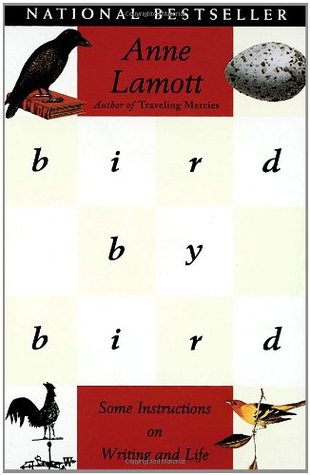
So I know that I am coming late to the party with this, but I finally got around to reading the much-recommended Bird by Bird: 12543Some Instructions on Writing and Life by Anne Lamott (New York: Random House, 1995).  I started out reading a library copy, and after finding something on every other page that I wanted to highlight, I gave up and bought a copy.  After about two chapters, I already knew that this was going to be a book that I wanted to keep on my desk and go back to again and again.

The thing is, Lamott doesn’t really cover anything you don’t already know as a writer – but her humorous insights give you permission to own up to those things you already know.   They make you feel a little less alone.  And if you’re a Type-A personality like me, they help take some pressure off.  I love her idea of the “1-inch picture frame”, or focusing only on the tiny little bit of story that you are working on right now, without getting bogged down by bigger questions.  This description, this interaction.   Because you’ve just got to get on with it.   As Lamott says: 

“And the story begins to materialize, and another thing is happening, which is that you are learning what you aren’t writing, and this is helping you to find out what you are writing.”

Yes!  So, see?  All my writing around the point?  Not wasted. 

I recently read a perfectly reasonable article in Writer’s Digest that made me want to throw the magazine across the room: “7 Steps to Creating a Flexible Outline for Any Story” by K.M. Weiland.  In it, Weiland advocates doing a great deal of up-front work in setting up the plot, characters, and setting of your story in outline form, so that you don’t waste time going down pointless paths later while writing.  Now, this is an admirable approach, and I am glad it works for her.  But I am Type-A, get-it-done, even-my-to-do-lists-have-to-do-lists kind of person, and even I felt it was a bit much.  I can’t imagine how a true “pantser” (those writers who plot by the seat of their pants) would react to it. 

Here’s the thing: I would love to be able to be that organized when it comes to developing a story, but that’s just not how it works for me.  Don’t get me wrong, I do a lot of planning up front – for my current work-in-progress, for example, I had an entire notebook full of character information, family trees, plot notes, research notes, and so on, before I put word one on the page.  But to me, it feels forced to try to jam all that into an outline too soon.  So much of the story reveals itself to me as I write it.  Even though I think I know the characters well, they tell me new things about themselves as I let them interact with other characters.  So for me it’s important to let those characters unfold that way, and let the plot flow from that.

Weiland’s article definitely has a lot of good stuff in it.  But I know that, for me, following it to the letter would be too confining.

And isn’t that what this writing thing is all about, anyway?  You have to find the approach that works best for you and keep at it.  Anne Lamott has a great quote about that too:

“You get your confidence and intuition back by trusting yourself, by being militantly on your own side.”

Amen, sister.


Writing Around the Point

Whenever I sit down to work on my novel in progress, I try not to think too hard about the fact that I am eventually going to cut 70-90% of what I write on any given day.  It’s painful to think about, even if it’s necessary.

So it’s weird that I have totally embraced another writing technique: writing outtakes.  For my current work in progress, I have written nine different outtakes and extra scenes, ranging in length from 15,000 words to 22,000 words.  Every time I do it, I feel like I am wasting time, or at the very least, indulging in what I like to call “productive procrastination”.  (If you spend your time organizing your to-do list to avoid actually doing anything on it…that’s productive procrastination.)  Some of these stories are scenes from the novel in other points of view, some are completely separate, some are background information that I need for the main story.  At two key points in the story, where several characters converge, I actually found it helpful to write the scene in several other characters’ points of view BEFORE I tackled it from my main character’s viewpoint.

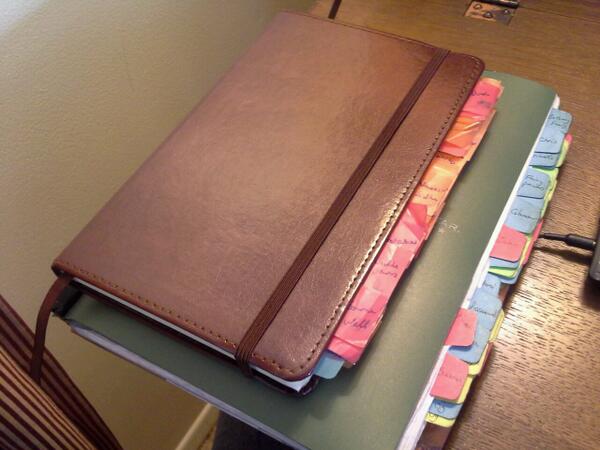
So now, whenever I am struggling with my manuscript, I set it aside and choose another character to write about, or pick a moment in the past to write about.  Then when I come back to the main manuscript, more often than not, I have a much better idea of how to proceed.  It makes sense; if you got stuck writing an article or nonfiction topic, it would probably be because you need to do more research.  These side stories are “research” on my characters.  I have pages and pages of notes…

notes


…but for some reason it doesn’t all become “real” to me until I write it in prose form.  My characters tell me things I hadn’t known before when they start interacting with others.

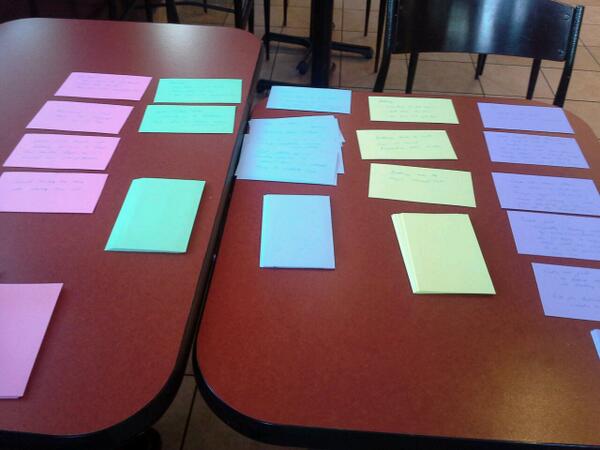
Right now I am finally working on the climactic scene of my work-in-progress, a scene where five characters and their messy hopes, desires, and insecurities collides.  I tried plotting it using color-coded index cards…

cards

…scribbling notes in notebooks, adding half-formed notes to Word documents.  And I have been working on this scene from the other characters’ points of view first, starting with the villain.  (Writing in her point of view may not be healthy, but it’s useful.)

So here’s my resolution: I am no longer going to let myself feel guilty about this.  It’s not a waste of time.  It’s necessary to make the final product better, because when it comes to writing a great story, there’s just no way to rush it.