Category Archives: Recommended Reading

An Interview with Megan Morrison, Author of GROUNDED: THE ADVENTURES OF RAPUNZEL

I recently had the enormous pleasure of interviewing my good friend, Megan Morrison, about her debut middle grade novel, GROUNDED: THE ADVENTURES OF RAPUNZEL, for the Sweet Sixteens’ debut author interview series, The Debut Club. This is an extended version of that interview, in which we learn more about Megan’s influences as a writer and friends from her past return to ask her tough questions.

Megan and I have been friends for almost fifteen years. We first met bonding over Hermione-centric Harry Potter fanfiction, and the intervening years have held lots of obsessing over fictional characters, matching tattoos (quills, if you must know), and writing – so, so much writing. I am so proud of Megan and what she has done with the Tyme series, and I can’t wait for everyone to read it!

More about Megan:

HiRes_Morrison_6814_cropMegan Morrison spends her time having adventures with her husband and little boy, teaching drama and language arts to 7th and 8th graders, and writing fairy tales set in the world of Tyme, which she co-created with Ruth Virkus. When she’s not busy working on something or other, she enjoys obsessing over other people’s stories. She’s a huge, dress-up-in-costumes-and-scream-a-lot level fan of Harry Potter, Jane Austen, Star Wars, Firefly, and BioWare’s role-playing games. She lives in the Pacific Northwest, where she enjoys nature and coffee.

Find Megan on her website, Twitter, Facebook, and Goodreads.

About GROUNDED: THE ADVENTURES OF RAPUNZEL

grounded_cover (3)Published by Scholastic/Arthur Levine Books, April 2015

You know about the tower, the hair, and the witch. But in the world of Tyme, they’re only the beginning . . .

Rapunzel knows only her magical tower and her wonderful Witch, who guards her against evil princes far below. But when a peasant named Jack climbs into her life, Rapunzel learns that Witch is in terrible danger — and to keep her safe, she must leave her tower and journey with Jack on a quest far across Tyme. There she finds a world filled with even more peril than Witch promised . . . and more beauty, wonder, and adventure than she ever dreamed.

GROUNDED: THE ADVENTURES OF RAPUNZEL is the first book set in the land of Tyme — with many tales to come. It is available for purchase at Amazon, IndieBound, Barnes and Noble, Books A Million, and Powell’s.


And now, the interview!

Continue reading An Interview with Megan Morrison, Author of GROUNDED: THE ADVENTURES OF RAPUNZEL

Betty May: Exploring the Struggles of Women Behind Bars

When I was a child, I had the incredible good fortune to meet a woman who would shape the person I became, whose energy and belief in others helped me bettyevolve from a shy little girl who cried in the bathroom to a singing and dancing young woman who went after her dreams. That was Betty May, director of Onstage Productions, the theater group I was involved with for over ten years.

To anyone who knew her, it was no surprise that Betty continued to use her theatrical gifts to reach out to others after our theater closed. She’s been a high school teacher, a circus coach, and a clown. She went to Central America and founded a children’s theater company in a Guatemalan squatters’ settlement. And then, in 2008, she responded to an invitation to work with female prisoners serving life sentences to create a play about their experiences.

untitledNow, she has written a book about these women’s experiences: Faces: Imprisoned Women and Their Struggle with the Criminal Justice System (CreateSpace, 2014). The book also follows Betty’s own journey through the criminal justice system as she directed their original play warning young people about the consequences of bad choices. That work led to the Kennedy Center tapping Betty to write and direct a production featuring plays by prison inmates performed by professional actors.

Faces is an inspiring, eye-opening, and at times difficult and upsetting, read. Betty May invites us to examine our criminal justice system and the ways it often penalizes those it was designed to protect. She takes the reader along with her as she enters the prison gates and meets the real people behind the headlines.

Read the first chapter of Faces: Imprisoned Women and Their Struggle with the Criminal Justice System here.

Betty is a dynamic, passionate speaker and is available for speaking engagements at schools, libraries, and other community groups. Find out more at http://bettymayauthor.com/


New Favorite, Old Favorite: Just Like the Movies and The Unlikely Romance of Kate Bjorkman

just like the moviesNot long ago I had the pleasure of reading Kelly Fiore’s Just Like the Movies, the story of two unlikely friends who set out to recreate scenes from their favorite romantic films in their own lives.  Marijke and Lily are two girls with a plan…now if only the boys would fall into line.

(I should mention that I was reading this book while directing Deaf Camp, and that it kept me up for hours reading even after I had been corralling middle schoolers in the woods all day.  That should tell you something about how engrossing it is!)

The heroines of this novel combine heartfelt yearning with a canny ability to analyze the tropes of the movies they adore so much – and that reminded me of an old favorite of mine, The Unlikely Romance of Kate Bjorkman by Louise Plummer.  Though published way back in the dark ages of 1995, Plummer’s novel features a canny, smart heroine who would have been comfortable plotting alongside Marijke and Lily.  (Though I guess she’d be quite a bit older now – so I will just imagine her as their English teacher, watching their antics from behind Tina Fey glasses.)  Kate’s thing was romance novels, not romantic films, but her take on them was just as fresh and funny as Marijke holding an iPod dock unlikelyblaring “In Your Eyes” in her boyfriend’s backyard.    Despite the fact that Kate warns readers in the second sentence of the book that it’s “one of those romance novels.  You know, that disgusting kind with kisses that last three paragraphs and make you want to put your finger down your throat to induce projectile vomiting,” her attempt to tell her tale as a romance novel (complete with revision notes) is involving and funny and something that is still in my mind almost twenty years later.

So do yourself a favor and get a hold of both books to meet Kate, Marijke, and Lily, three girls who discover that grand gestures don’t change a thing in real life,  and that real love isn’t like a book or movie – it’s better.

Everyday Evil

I recently finished The Lucifer Effect: Understanding How Good People Turn Evil by Philip Zimbardo (Random House, 2007).cover of The Lucifer Effect

This book was extremely hard to read.

So hard, in fact, that I actually used up all twenty renewals on the library copy I had, and had to return it and get a new copy.   (That means it took me over a year to read the whole thing.)  I would read a chapter or two, and then need to put it down.  The descriptions of real-life evil acts conducted by ordinary people were just too intense to bear for long.  Sometimes it was weeks before I could pick the book up again.

Zimbardo is best known as the head of the Stanford Prison Experiment, a seminal experiment in social psychology in which middle-class 1970s college students played the roles of prisoners and guards while researchers explored the powerful effects of situation in shaping behavior.  The experiment was shut down prematurely when the situation drew out dehumanizing tendencies not only in guards, but in the researchers themselves, who played administrators in the false prison.  Rattled by the personal and professional effects of the experiment, Zimbardo has made it his life’s work to pursue an understanding of how situational factors influence human behavior.  In this book, he describes the experiment in sometimes painful detail and connects its lessons with other atrocities of aggression and omission, from the abuses of prisoners at Abu Ghraib to the murder of Kitty Genovese.

We Americans, in particular, tend to think of ourselves as unique individuals, deciding our own fates, but research shows that we all have “situated identities” – that is, we behave in different ways in different situations, and those ways are shockingly easy to predict.  In fact, Zimbardo argues that it’s easy to predict your behavior based on your ethnicity, social class, education, religion, and where you live – with no knowledge of your social class at all.

If our identities are largely socially constructed, then it make sense that good people often fall prey to situational logic, where our involvement in a group may encourage us redefine our behavior as something better than it is, lose our sense of personal responsibility, or dehumanize others because the group demands it.  Anyone who has experienced middle school knows that this is so – what disturbs me most is that the evidence shows that we don’t necessarily grow out of it.

We can’t be hermits, so we have to maintain our critical facilities at all times.  Zimbardo says this best: “We must regularly assess the worth of our social involvements.  The challenge for each of us is how best to oscillate between two poles, immersing fully and distancing appropriately.”

As fiction writers, we need to be keenly aware of the pull of situational factors on our characters.  It’s not enough to know that a character is spunky, or passive, or riddled with self-doubt, or charismatic.  Even more important to his or her behavior is the setting, the social expectations, the groups of which the character is a member.

Though The Lucifer Effect was a difficult read, I am glad I made it through.  The book maintains unflinching allegiance to the truth, to the underlying belief that shines through even the darkest descriptions that, while evil is frighteningly banal, so is heroism.  Because in the end, Zimbardo illuminates the fact that “we are all heroes in waiting”.


Pressure

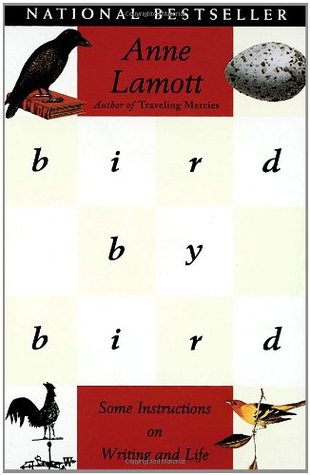
So I know that I am coming late to the party with this, but I finally got around to reading the much-recommended Bird by Bird: 12543Some Instructions on Writing and Life by Anne Lamott (New York: Random House, 1995).  I started out reading a library copy, and after finding something on every other page that I wanted to highlight, I gave up and bought a copy.  After about two chapters, I already knew that this was going to be a book that I wanted to keep on my desk and go back to again and again.

The thing is, Lamott doesn’t really cover anything you don’t already know as a writer – but her humorous insights give you permission to own up to those things you already know.   They make you feel a little less alone.  And if you’re a Type-A personality like me, they help take some pressure off.  I love her idea of the “1-inch picture frame”, or focusing only on the tiny little bit of story that you are working on right now, without getting bogged down by bigger questions.  This description, this interaction.   Because you’ve just got to get on with it.   As Lamott says: 

“And the story begins to materialize, and another thing is happening, which is that you are learning what you aren’t writing, and this is helping you to find out what you are writing.”

Yes!  So, see?  All my writing around the point?  Not wasted. 

I recently read a perfectly reasonable article in Writer’s Digest that made me want to throw the magazine across the room: “7 Steps to Creating a Flexible Outline for Any Story” by K.M. Weiland.  In it, Weiland advocates doing a great deal of up-front work in setting up the plot, characters, and setting of your story in outline form, so that you don’t waste time going down pointless paths later while writing.  Now, this is an admirable approach, and I am glad it works for her.  But I am Type-A, get-it-done, even-my-to-do-lists-have-to-do-lists kind of person, and even I felt it was a bit much.  I can’t imagine how a true “pantser” (those writers who plot by the seat of their pants) would react to it. 

Here’s the thing: I would love to be able to be that organized when it comes to developing a story, but that’s just not how it works for me.  Don’t get me wrong, I do a lot of planning up front – for my current work-in-progress, for example, I had an entire notebook full of character information, family trees, plot notes, research notes, and so on, before I put word one on the page.  But to me, it feels forced to try to jam all that into an outline too soon.  So much of the story reveals itself to me as I write it.  Even though I think I know the characters well, they tell me new things about themselves as I let them interact with other characters.  So for me it’s important to let those characters unfold that way, and let the plot flow from that.

Weiland’s article definitely has a lot of good stuff in it.  But I know that, for me, following it to the letter would be too confining.

And isn’t that what this writing thing is all about, anyway?  You have to find the approach that works best for you and keep at it.  Anne Lamott has a great quote about that too:

“You get your confidence and intuition back by trusting yourself, by being militantly on your own side.”

Amen, sister.